Athens: antiquity in the present tense
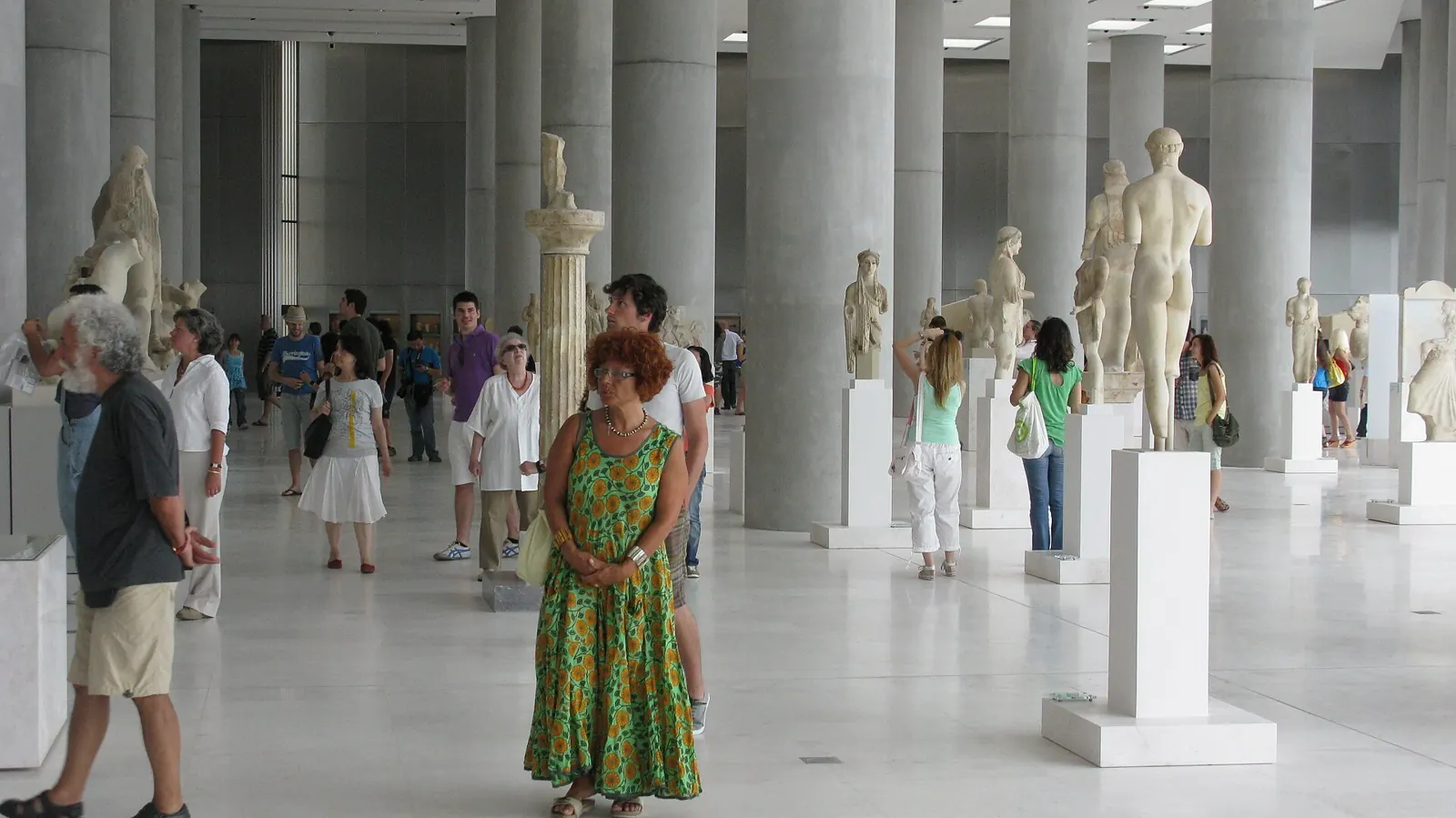
Most museums of antiquity take things away from where they were found and put them somewhere else. The Acropolis Museum does the opposite: it sits three hundred metres from the rock, looks straight at it, and keeps reminding you that the city it is about is still standing outside the window.
The building, by the Swiss-French architect Bernard Tschumi with the Greek architect Michael Photiadis, opened in 2009. It sits on stilts above an excavated neighbourhood, and you walk in over glass floors that show the streets, houses and drains of Late Roman and Byzantine Athens beneath your feet. Before you have seen a single statue, the museum has made its argument: the past here is not a collection; it is the ground.
A gallery aligned with a temple
The top floor is the reason to come. The Parthenon Gallery is turned slightly from the rest of the building so that it lines up exactly with the Parthenon, visible through its glass walls, and it has the same dimensions as the temple's inner chamber. The frieze runs around it at eye level, in the order it once ran around the temple, so you walk the Panathenaic procession as an ancient Athenian might have walked around the building, except that you can see every horse and every fold.
The frieze shows the great procession of the Panathenaia, held every four years in honour of Athena: horsemen, chariots, musicians, young women carrying vessels, sacrificial cattle, and at the culmination, above the temple's entrance, the folding of the new robe made for the goddess's ancient statue. On the building it was high up, in shadow, and barely visible; here it is at eye level, in a glass room flooded with light, and you can see that the sculptors carved even the parts nobody was supposed to see.
Many pieces are not the originals. Where the marble is in London, at the British Museum, the museum shows plaster casts, a paler white. The effect is deliberate and powerful: the gaps are visible, and the argument for their return is made without a word, simply by turning your head from the casts to the temple on the hill.
The argument is made without a word, by turning your head from the casts to the hill.
Colour, and the archaic smile
Don't rush past the first floor, where the archaic sculptures stand in a hall full of daylight. These are the statues of the Acropolis before the Parthenon: the young women called korai, with their braids and their fixed, faintly amused smiles, and the Moschophoros, a man carrying a calf on his shoulders as gently as a child. Many korai still carry traces of paint, red on the lips and patterns on the dresses, and the museum shows reconstructions of their original colours. Antiquity, it turns out, was never white. That is another of the museum's quiet corrections.
Five women and a gap
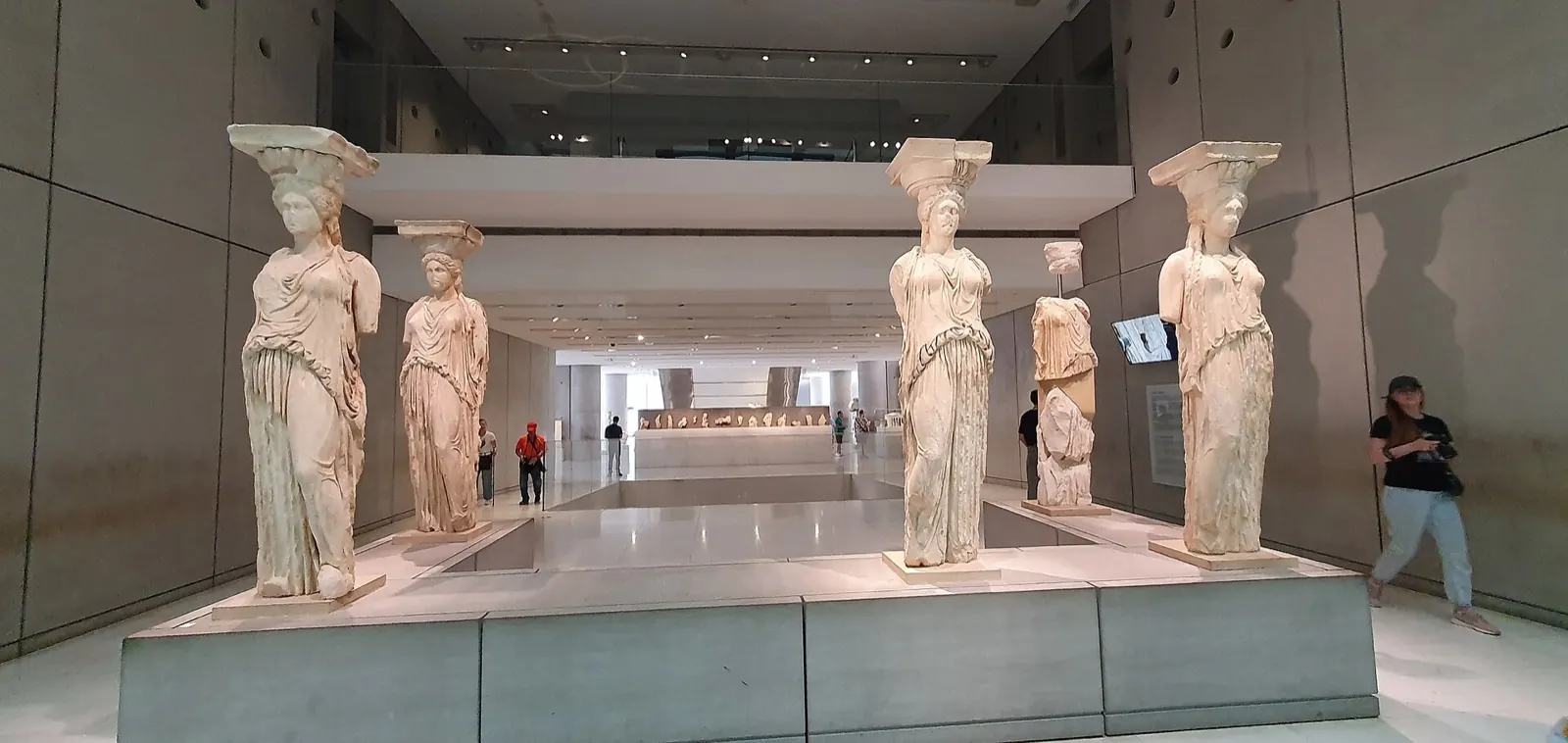
On the floor below stand the Caryatids, the five marble women who held up the porch of the Erechtheion; the sixth is also in London. Cleaned with lasers, they have the colour of skin in winter. Their hair is braided in elaborate patterns, each one different. They were made to carry weight, and they do it with a kind of ease that makes the whole idea of a column look clumsy.
The path from the broken houses
Now leave the museum, cross the road, and climb the hill opposite, Philopappou. This is the connection I want you to make. Between 1954 and 1957, the architect Dimitris Pikionis laid out the paths around the Acropolis and up this hill. He used stone and marble fragments salvaged from the neoclassical houses of Athens that were being demolished all around him, and set them by hand into the ground, piece by piece, in patterns that never repeat: a modern mosaic underfoot, made from the debris of the city's own recent past.
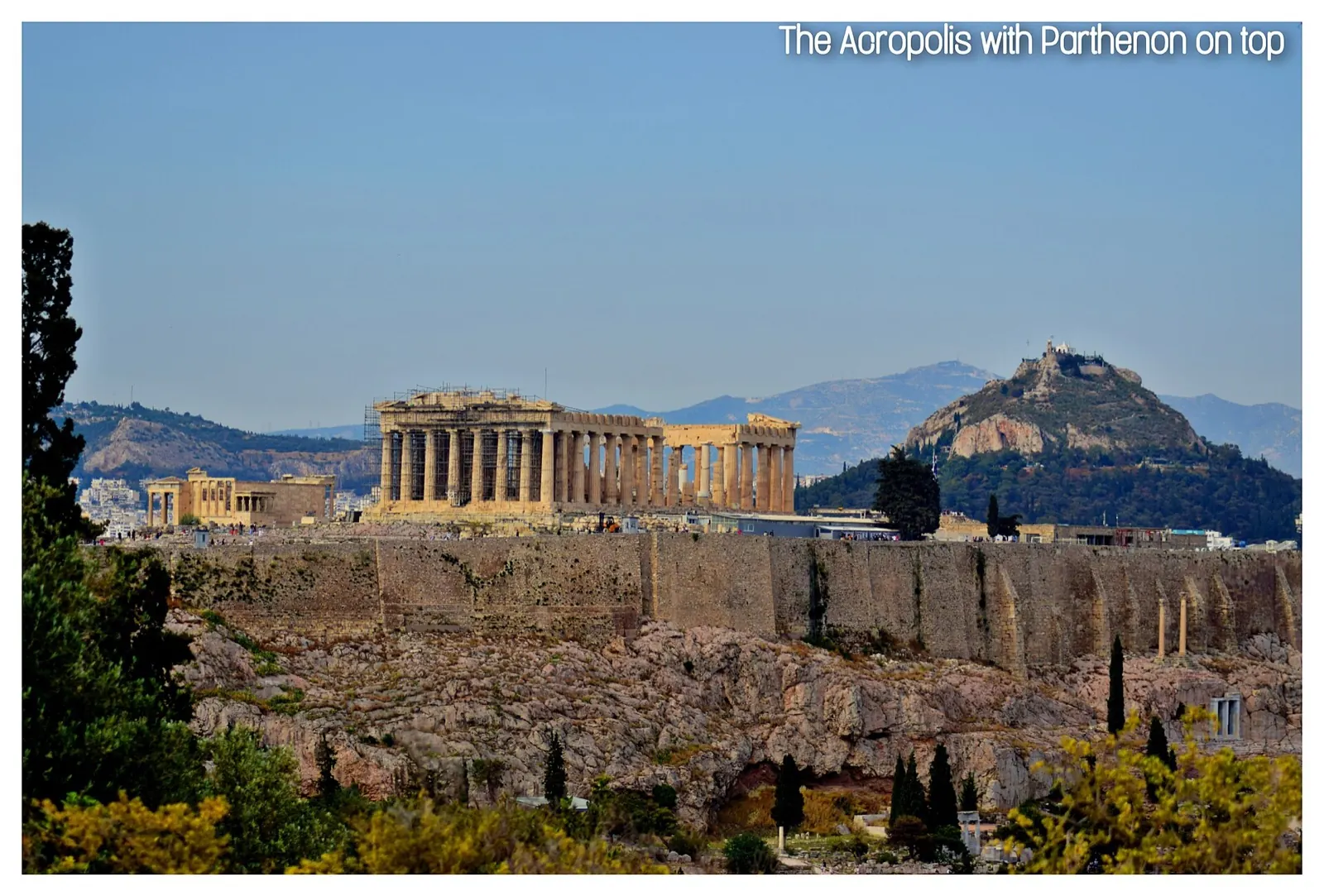
On the way up is the little church of Agios Dimitrios Loumbardiaris, which he restored, and a small pavilion he built beside it. From the top, you look across at the Parthenon, and back down at the museum, and you understand that the two architects were answering the same question fifty years apart: how does a modern city live with the most famous ruin in the world? Tschumi answers with glass, alignment and absence. Pikionis answers with his hands, by making the walk to the temple out of the pieces of Athens that the 20th century threw away.
The connection runs further. The same city that demolished its neoclassical houses for apartment blocks in the 1950s and 60s produced, in the polykatoikia, the concrete apartment building with its deep balconies, a modern architecture of its own that is now admired by architects everywhere. Athens has always rebuilt itself out of its own ruins. Pikionis simply made that visible, and beautiful.
If you have another day, take the metro to the National Archaeological Museum, which holds everything the Acropolis Museum does not: the gold of Mycenae, the bronzes pulled from the sea, the Antikythera mechanism. The two museums are a pair, one about a single rock and one about the whole Greek world, and together they make the strongest case anywhere for seeing ancient art in the country that made it.
How to do it
Go to the museum in the afternoon, when the light in the Parthenon Gallery turns warm. Have a coffee on its terrace, facing the rock. Then walk up Philopappou for sunset, on Pikionis's stones. Save the Acropolis itself for the next morning, at opening, before the heat and the crowds; you will see it differently.
Filed under: Places · Athens · Athens city guide · All Curator's Highlights
More Curator's Highlights
Marseille, the Surrealists' waiting room
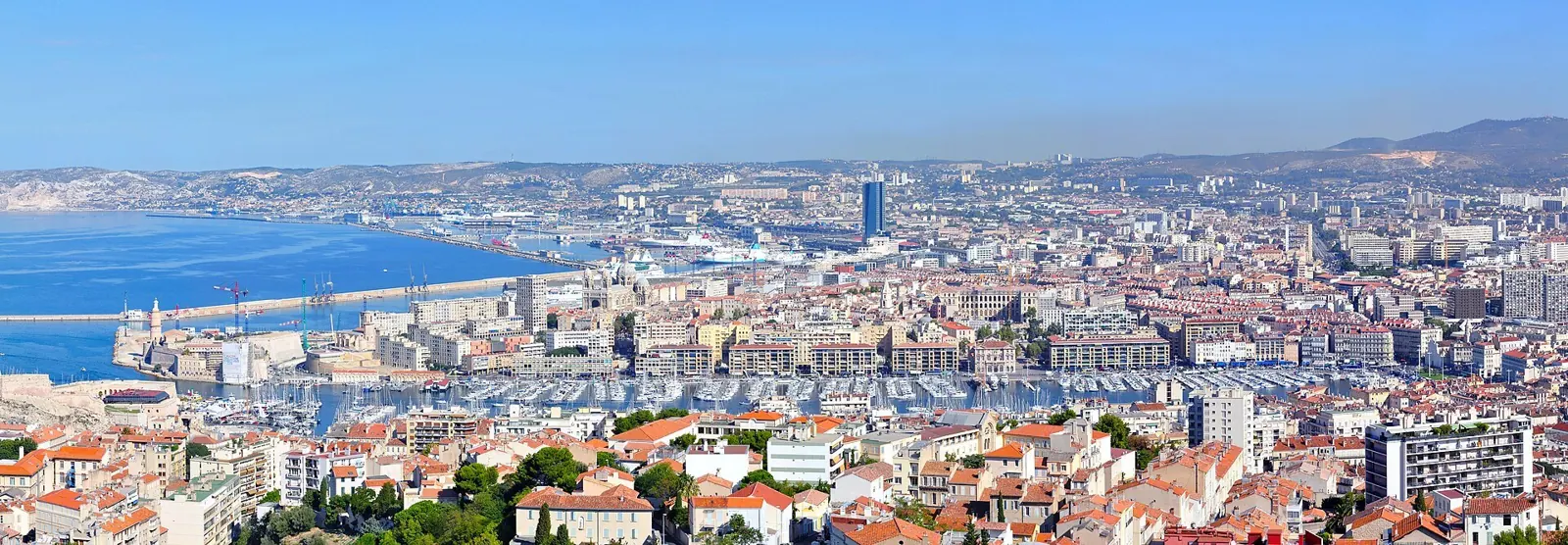
In 1940–41, the Surrealists waited here for visas to escape the war, and left behind a deck of cards.
Kim Swoo-geun's Seoul
Brick, concrete and a small theatre in a basement: the architect who gave modern Seoul its spaces.
A house built to be haunted by objects
The architect kept everything, and an Act of Parliament made sure nothing would ever move.